Wild animals as the training ground for calmer, more confident decisions: an elephant, a vulture, a zebra, a giraffe, a lioness and a baboon.
See all 6 stepsWhat you'll be able to do
- Measure the gaps between legs and features as negative space to get each animal's proportions right.
- Use the eraser positively in pencil to refine shapes before committing with a permanent fineliner.
- Wait a minute for the ink to dry, then rub out the pencil so washes stay clean.
- Mix two complementary colours with white into a soup and build the animal from that neutral.
- Pop black brush pen in, then blend it down with a light grey for soft three-dimensional form.
- Give every animal its setting with grasses, trees and horizon so it never floats in space.
About this course
Overview
Sketch Wild Animals with Confidence, Character, and the Landscapes They Belong To
Six animals. Six African landscapes. The moment your sketches start telling stories.- 6 Animals
- 5 Technical Exercises
- 5 Bonuses
Learn to sketch character, not perfection
What do giraffes, elephants and vultures have to do with urban sketching? Turns out everything.
Not anatomy.
Not realism.
Not perfect outlines.
Instead, it’s about learning to see weight, movement, mood, and story, and how to translate those qualities into confident, meaningful marks on the page.
This course grew from a simple idea. A set of safari photographs taken in Kenya. When these images were shared with Ian, what stood out was not the subject, but the behaviour. The pauses. The patterns. The quiet confidence or restless energy in each animal.
Those moments became lessons.
This is not a wildlife art course
You do not need to know anything about animals.
You do not need to draw fur, feathers, or faces accurately.
You do not need to work fast or draw from life.
This Sketch Safari Course is about learning how to make better sketching decisions, using animals as forgiving, expressive subjects.
Many students are surprised to discover that sketching animals improves their urban sketching. Buildings feel easier. People feel less intimidating. Marks feel more intentional.
Why?
Because animals remove the pressure to be perfect.
The animals and what they teach
Who it's for
How easy is this course for a complete beginner?
This course is very beginner friendly. You do not need any previous experience drawing animals, people, or urban scenes. Ian teaches you how to make simple, confident decisions rather than how to draw perfectly, so even hesitant sketchers quickly find their feet. Many students begin feeling unsure and finish feeling calmer, more deliberate, and more confident in their marks.I usually sketch buildings. Will this course still help me?
Yes, and this often surprises people. The skills taught in Sketch Safari are core urban sketching skills. Seeing shape, judging weight, simplifying complex subjects, using tone with restraint, and knowing when to stop all transfer directly to buildings, streets, and people. Many students find that after sketching animals, architecture feels easier and less intimidating.Outcomes
Across the course, you will learn how to:
- Start with big shapes instead of chasing perfection
- Use tone and hatching to suggest weight and form
- Create depth and grounding without adding detail everywhere
- Let pattern guide the eye through a sketch
- Decide what to leave out, and when to stop
These are core urban sketching skills. They just happen to be taught through elephants, vultures, zebras, giraffes, lions, and baboons.
Each lesson focuses on one image and one main idea, so you are never overloaded or rushed.
Your learning path
6 workshops, in the order Ian teaches them. Work through them at your own pace; every step ends with a finished sketch.
Before you start
Intermediate level
Best if you have finished a beginner course or already sketched a few scenes of your own. New to sketching? Start with the Beginners Course.
Lesson 1
Elephant
Before your sketchbook fills with texture and detail, Ian teaches you to slow down - and see like a true artist.
You'll practise
- Start the elephant in Ultramarine Blue, then mix Burnt Sienna on the page to reach the grey.
- Follow the wrinkles of the trunk with brush pen, then smudge them soft with a lighter grey.
- Finish with thick Titanium White on a rigger for tall grasses crossing the legs in varied directions.
Read the full workshop notes
Lesson 1: Elephant
This lesson teaches you how to capture the quiet power of the elephant by focusing on shape, proportion, and presence. You’ll discover how to create a sense of weight and calm, even with the softest marks.
Instead of rushing into the details, you'll practice patience - placing every line with purpose, every shadow with restraint. The landscape becomes part of the story, revealing not just the animal’s size, but its place in the world.
By the end, you won’t just have drawn an elephant. You’ll have learned how to anchor your subject, compose it with confidence, and the tricks for letting form speak for itself.
Lesson 2
Vulture
This lesson is about control - not overworking, but observing .
You'll practise
- Draw the head and beak slowly and precisely, then loosen up completely for the dead branches.
- Use a 0.2 for the bird and a 0.3 for the foreground branch to separate the layers.
- Leave the crossing branch white while the body is wet, then shape it later with brush pen.
Read the full workshop notes
Lesson 2: Vulture
The vulture teaches you to create presence with precision: soft shadows, muted tones, and contrast placed with care.
You’ll learn how to suggest form without outlining every feather - using negative space to shape the body, and saving your boldest lines for the claws and key edges.
The result is stillness, strength, and volume without noise.
It’s a powerful shift: knowing what to leave out - and trusting that one shadow, placed with intention, can speak for an entire wing.
By the end of this lesson, you’ll come away with the confidence to let your work breathe, and the eye to know when less is more.
Lesson 3
Zebra
In this lesson Ian shows you what it means to commit - to move with purpose, and let your lines carry life.
You'll practise
- Draw each stripe as a single line for direction, then thicken it later with brush pen.
- Read the stripes as perspective, straight on the flat neck and curving as the body turns.
- Paint the body in Cerulean and Cadmium Red with white, ignoring the stripes until dry.
Read the full workshop notes
Lesson 3: Zebra
You’ll sketch the zebra not through stiff outlines, but with bold, continuous strokes that follow the curves of the body. As your pen moves, the animal takes shape - full of rhythm, movement, and confidence.
Using brush pens and fineliners, you’ll layer tone quickly and confidently. The background stays soft and spacious, creating depth without distraction - and showing you that sometimes the space you leave blank speaks just as loudly as the lines you draw.
By the end, you’ll stop second-guessing. You’ll start trusting your eye - and yourself.
Lesson 4
Giraffe
This lesson is about learning to respond - not repeat.
You'll practise
- Let the markings shrink down the legs so they merge with the seed heads in the grass.
- Paint flat Burnt Umber markings first with a rigger, adding yellow further up the body.
- Model the giraffe with a wet brush and no paint, letting the brush weight move colour.
Read the full workshop notes
Lesson 4: Giraffe
Rather than repeating shapes mechanically, Ian shows you how to build the giraffe’s pattern slowly, letting each shape follow the form beneath it.
Some edges stay soft, others are defined - just enough to guide the eye without overpowering the sketch.
Grasses are added throughout, helping to place her in the landscape and create soft, natural layers of depth. It’s not about treating every part equally - it’s about knowing where to lead the viewer, and when to hold back.
By the end, you’ll understand how to create depth, variation, and flow - and how to let your subject emerge, one thoughtful mark at a time.
Lesson 5
Lioness
In this lesson, Ian teaches softness, stillness, and precision.
You'll practise
- Start with the off-centre nose and measure the mouth, eyes and ears from it.
- Change the hatching direction to follow the way the fur grows around the face.
- Leave the chin and sunlit edge white, and do the eyes and nose in brush pen.
Read the full workshop notes
Lesson 5: Lioness
You’ll use structured hatching to shape form gently - letting each mark follow the natural planes of the body. Every stroke matters. Nothing is rushed. The focus is on tone, not to fill space, but to suggest weight, posture, and peace.
Foreground grasses are placed sparingly to frame the lioness and hold her in the scene. And as for her face - it’s built with restraint. Just a few careful marks around the eyes and mouth are enough to carry the calm.
By the end, you’ll understand how to shape emotion through tone - and how to create stillness with absolute control.
Lesson 6
Baboon
This lesson is about letting go - of smoothness, tidiness, and perfection.
You'll practise
- Draw only the face carefully in pencil, since leaves and twigs go straight in with fineliner.
- Blast Winsor Violet and Green Gold wet on wet so the face sits in a deep dark.
- Stop a black twig where it passes behind a lighter branch to show depth.
Read the full workshop notes
Lesson 6: Baboon
You’ll use short, varied strokes to build texture and rhythm in the baboon’s fur, embracing energy over polish. Every mark carries intention. Tone is used with control - to shape the form, not flatten it.
The tree isn’t just a backdrop - its twisting branches and scattered leaves help frame the moment and add depth to the scene. As you sketch, let the lines move. Let them shift and change. Don’t aim for perfect - aim for alive.
By the end, you’ll have more than a textured drawing.
You’ll have a sketch that moves, breathes, and refuses to sit still.Together, they show you how character comes from decisions, not detail.
When you finish
What you'll have at the end
6 finished sketchesOne for every step, in your own sketchbook.5 bonusesExtra workshops and resources to keep going.Yours to keepCome back to any lesson whenever you like.
Why Safari Sketch Course?
Measure the gaps
You measure the gaps between legs and features as negative space, then refine in pencil before committing with permanent fineliner.
Calmer, surer decisions
An elephant, a vulture, a zebra, a giraffe, a lioness and a baboon become your training ground for making calmer, more confident decisions.
Give animals a setting
Every animal gets its setting of grasses, trees and horizon, so it never floats in space, and you paint it from a neutral mixed with white.
Ready when you are
Start Safari Sketch Course today
Short lessons, yours to keep, and a 30-day money-back guarantee.
What else comes with the course
3 extra workshops and resources are part of the course, so the learning carries on after the last location.
Included with this course
Gazelle
FREE WORKSHOP 1: Gazelle
Included with this course
Warthog
FREE WORKSHOP 2: Warthog
Included with this course
Flamingo
FREE WORKSHOP 3: Flamingo
About your instructor
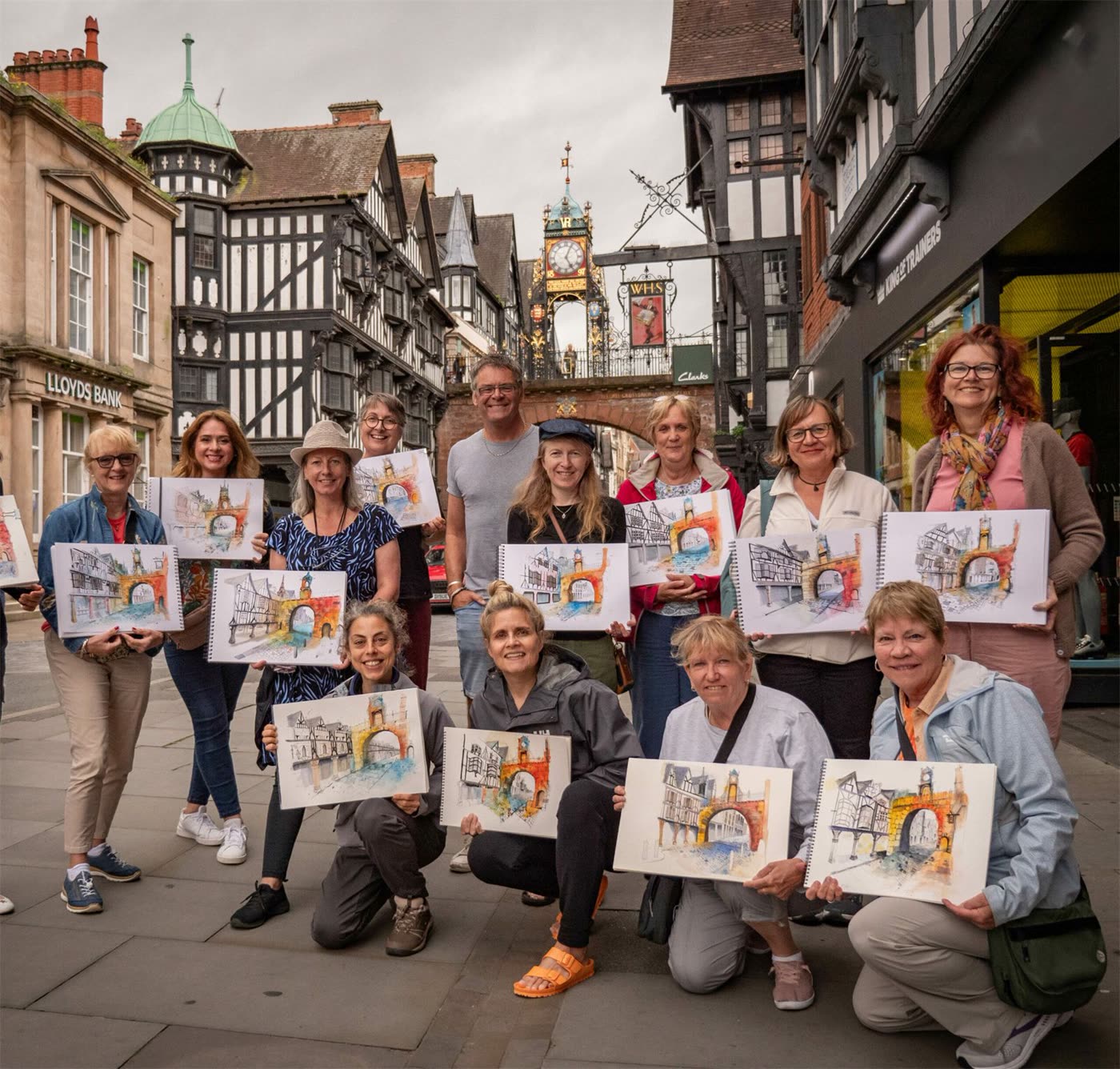
Ian Fennelly is the artist behind every Urban Sketch Course and the voice in every lesson. He sketches real places on location and talks you through each decision as he makes it, so you learn how he thinks as well as what he draws. In Safari Sketch Ian shows you how to capture the character of six animals, from the elephant to the baboon, along with the landscapes they belong to.
Sketches by students of this course
What students say
He absolutely loved doing it and is absolutely hooked on sketching!
Lindy Hyam
I love the way Ian talks about the subject of Urban Sketching and is so enthusiastic. Best of all when he says it doesn’t need to be be perfect😉 as I am new to this form of art and tend to want to add too much detail. The course is easy to follow with videos of each step along the way. I am keen to do a lot more Urban Sketching after enjoying this course
Cynthia Walton · Review on Trustpilot
He's funny, informative and entertaining while guiding you step by step along the way! Of course, I love his style, but best of all he's helped me find my own artistic voice!
Joanie Crombie
I'm 61 years young and took up watercolours after retiring from nursing. I've taken a few online classes and this one is my absolute favorite!
Mary Baldree
I have purchased all they have and improved as an artist (yes, I now feel I can call myself an artist :-) beyond what I could have ever hoped.
Scott Peterson
The course for beginners was a great benefit for me. I really learned a lot, how to phase my work, how to make perspective, how to make and use presketch, how to mix colours and use water, toning... My pictures got depth and look better. Thank you very much.
Andrea Kolarikova
Ian brings joy and exploration energy to learning. While he has specific techniques he imparts, his enthusiasm for playing around comes through and is infectious. Several people noticed the shift in what I was making once I started with him. It’s now been 4 years, and I’ve loved all of it.
Gretchen Anderson
Fun to draw, loved the approach that Ian guided us through. Loved the use of the white to pop out the rest of the drawing.
Kerrie Edwards
I love this project, my only regret is that I can’t seem to create the light and delicate touch that seems Ian creates do easily!
Marian Pooran
With the brush pens it started to get better and I really enjoyed the detail.
Chantal Aelbrecht
I am home bound and can't go out to sketch, but thanks to these wonderful tutorials I can sketch along and have the joy of painting.
Melissa McCutcheon
I wanted something more artistic, with a lot more colour, where I could slow down.
Asmita Kapadia
I started the membership in February 2023 and it has become a very important part of my life.
Anja Saalberg, UrbanSketch+ member
The community of this Urban Sketch Course is just so uplifting, everyone is so supportive
Marlies
This is a very good course, it can be taken in slow easy steps at your own pace. You can also dip in an out is you have forgotten a step.
Sarah Vipond
A very satisfying lesson and I am pleased with the outcome.
Keith Scholes
Ian’s breakdown of steps through the sketch are very helpful.
Ron Dean
Really haven’t had time to start the course but I know if you guys made it it will be worth my while. Every course that I have bought has been and I have a lot of catching up to do. I’m only about 25 drawings behind. No worries I’ll get to them.
Richard den Braber · Review on Trustpilot
This was challenging using colours that needed to be transparent, but in the end, the idea of layering made sense to me & I like the result!
Elena L
More about this course
Why This Course Matters for You
If you loved the Zoo Course, you’re going to feel right at home on the Sketch Safari.
In fact, the Zoo Course has become our most popular ‘transferable skills’ course because it’s all about learning to see quickly and sketch confidently, without all the pressure that sometimes creeps in when drawing buildings. Animals don’t sit still (and they certainly don’t care if you get their proportions slightly wrong), which means you can stop overthinking and just respond to what you see in the moment.
It’s fun, it’s fast, and it frees you up to make bolder decisions.
But That's Not All...
Bonus #1: Quick Sketching Workshops
Ian wanted to help you build even more confidence drawing animals so he’s created a special Bonus Bundle of extra workshops just for Sketch Safari.
These aren’t just extra videos – they’re creative challenges to help you loosen up and see animals in new ways. You’ll explore a techniques of quick sketching to build the bones of a subject keeping things bold and simple, and a continuous line drawing that captures the movement and character of your creature without ever lifting your pen.
Add PLUS to your account when you purchase this course to unlock 5 extra portraits!
Proof Ian's Teaching Works
Over 100,000 people have taken Ian's courses, with hundreds of 5-star reviews posted to trusted sites like Trustpilot:
30 days
30-day money-back guarantee
If the course is not for you, tell us within 30 days of buying and we will refund you in full.
Ready when you are
- 6 workshops, each a full sketch from first line to last wash
- Lifetime access: watch, pause and rewatch as often as you like
- Resources, reference photos and colour notes to keep
- 30-day money-back guarantee
Join 100K+ people learning with us.
Frequently asked questions
Is this a wildlife art or animal anatomy course?
This is not about learning animal anatomy, memorising features, or drawing realistic fur or feathers. Animals are used because they are expressive, forgiving subjects that help you practise observation, decision making, and mark making without the pressure of being “right”.
You are learning how to sketch, not how to become a wildlife artist.
Do I need to draw quickly or sketch from life?
All lessons are taught from photographs, and you can work at your own pace. Some exercises encourage looseness or time limits, but these are always explained clearly and are about building confidence, not speed.
You are never rushed, and you can pause, rewind, or revisit lessons whenever you wish.
What is the difference between Sketch Safari and the Urban Zoo Course?
The Urban Zoo Course is focused on sketching animals quickly often using a single material which then builds up into adding paint. Each subject is treated as a standalone figure, helping you loosen up, work boldly, and capture character without getting caught up in detail.
Sketch Safari is broader and more reflective. It shows you Ian Fennelly’s full "Layers of Looking" urban sketching methodology, applied to animals within the African landscape. Instead of concentrating on one material or one fast approach, you explore how shape, tone, line, pattern, restraint, and composition work together to tell a story.
In Sketch Safari, the animal is not isolated from its surroundings. It is grounded in place, atmosphere, and context, in the same way Ian approaches buildings and streets in his urban work.
Many students enjoy the Zoo Course as a confidence building, energetic introduction to animal sketching, then find Sketch Safari deepens their understanding of how and why they make each mark, bringing more intention into all of their sketching, not just animals.
Can I follow along with Ian while taking the course?
Yes.
Each lesson is structured so you can sketch alongside Ian step by step. He talks through what he is doing, why he is doing it, and just as importantly, what he is choosing not to do.
Many students find this way of working far less overwhelming than traditional drawing tutorials.
What materials do I need?
You do not need expensive or specialist equipment.
Ian works with simple, accessible tools such as pencils, fineliners, and brush pens. You can use what you already have and gradually build your kit if you wish.
Clear guidance is given so you always know which materials are being used and why.
How long will the course take to complete?
The course is designed to fit around your life.
Each workshop can be completed in one sitting, but many students prefer to spread lessons out, revisiting them several times. There is no deadline, no schedule to keep up with, and no pressure to finish quickly.
You are encouraged to take your time and enjoy the process.
How easy is the online platform to use?
The course platform is straightforward and designed for ease of use, even if you are not especially confident with technology.
Lessons are clearly laid out, videos are easy to play, and everything can be accessed from a computer, tablet, or phone. Help is always available if you need it.
Do I get lifetime access to the course?
Once you enrol, you have lifetime access to the entire course, including all updates. You can return to the lessons whenever you want, for refreshers, inspiration, or quiet sketching time.
What if this course is not right for me?
You are fully protected by a 30 day money back guarantee.
If you try Sketch Safari and feel it is not what you expected, you can request a refund within 30 days. There is no risk in giving it a try.
I am an UrbanSketch+ member. Do I get anything extra?
UrbanSketch+ members receive an extra 10% off as well as additional community benefits, including access to the additional sketching workshops and ongoing sketching support.
All PLUS members will receive two additional animals to sketch along with access to 20+ reference images to sketch from.
If you are already a member, Sketch Safari fits naturally alongside your existing learning and gives you another relaxed, confidence building way to practise transferable sketching skills.