
Five workshops in medieval York that teach you how to make old buildings look their age, with just four colours in each.
See all 5 stepsWhat you'll be able to do
- How to choose four colours for an old building before you start, and give each one a job in your sketch.
- How to mix two opposite colours into the browns and greys of old timber and stone.
- Where the deep darks go on an old building.
- How much paint a wall needs to look chalky and solid.
- How to keep one warm colour for the light, so an old street still has some sun on it.
- How to tone the colour down again once the paint is dry, and give the timber its texture.
- How to make a finished sketch with a pen alone, and no colour at all.
About this course
Overview
Ian Fennelly is famous for bringing buildings to life with bright colours. In Ye Olde Sketch Course, he does the opposite.
You'll start the course by making two shopfronts look their age, and you'll finish it with a whole ancient street in your sketchbook.
Workshop 1 is the gentlest. You paint two timber shopfronts on a corner and leave the rest of the street out. From there you take on more old timber buildings, and then a stone cathedral.
By Workshop 4, the most demanding one, you're sketching the Shambles, a street over 600 years old, and making it look its age. And Ian shows you how to do all of this with only four colours in each workshop.
You don't need to travel to one of England's most haunted cities to learn this. You can follow along with Ian from home, as he teaches you his tricks and techniques for sketching old buildings and making them look old on your page.
Why the old buildings most people draw come out looking like new-builds
Think of the oldest building you know. Dark beams that bend. Stone that's been rained on for hundreds of years.
You sit down and draw it. You take your time over the beams and the windows, then you paint it the colours you can see. But it comes out looking like it was built last year.
That happens not only to beginners: even experienced artists, who can draw buildings accurately, can still end up with something that looks new.
The drawing was never the problem. Age comes from three things: the colours you mix, the tone you lay over them, and the detail you add on top. Ye Olde Sketch Course teaches you all of this in step-by-step detail.
Who it's for
If you're new to sketching, old buildings forgive a wobbly line
Old buildings are forgiving subjects. Their beams bow and their walls lean, so a wobbly line belongs in scenes like this.
The lines you put down first stay in your sketch and become the grain of the wood or the bend of a roof. So, if you're brand new to urban sketching, you can start with the lines you draw today, wobbles and all.
You take the workshops at your own pace, pausing and going back over any step as often as you like. And if you already sketch, this is the first time Ian has taught how to make old buildings look old.
Outcomes
After this course, you'll be able to sit down in front of any old timber house, stone building, or ancient street, and make your sketch look as old as the place itself.
You'll know which four colours to reach for and how to mix them. More than that, you'll know how to get the age of a place onto the page, so the timber, the stone and the whole street look as old on paper as they do in front of you.
Show that sketch to someone and they won't need to be told it's old. They'll see it straight away.
Your learning path
5 workshops, in the order Ian teaches them. Work through them at your own pace; every step ends with a finished sketch.
Before you start
Beginner level
No experience needed. Ian starts every workshop from a pencil and a blank page and builds the sketch one stage at a time.
Workshop 1
Little Shambles
Your first sketch is two timber shopfronts on a corner of Little Shambles, a tiny side street running downhill off the Shambles.
You'll practise
- Lay the frame before the subject by letting the outside edge control everything inside it.
- Mix complements to calm the picture - Prussian Blue and Transparent Orange make the brown.
- Use the whole grey range by reaching for five values rather than just a black and a grey.
Read the full workshop notes
From the kerb where Ian works, you look at two medieval buildings falling away down the slope, their beams running off in every direction and their windows full of reflections.
Under your feet are old cobbles, and on the corner there's a sign so faded you can't tell what it says, so Ian leaves it blank.
On the same corner is the ghost shop where Ian bought a handmade ghost called Creepy Richard. It's a busy spot, and hundreds of people walk past while he sketches.
On one shopfront, you'll see why he drew two beams where there's only one, and why he added a touch of red to the scene.
By the end of Workshop 1, you'll have both shopfronts in your sketchbook looking their age, by learning how to mix a palette of just 4 colours. It's the first time Ian has taught how to use sepia.
After this, you can do the same with the old buildings where you live.
Workshop 2
King's Court
Next, you put down the colours of old timber in the right order, on three crooked buildings at King's Court, a small open space at the top of the Shambles.
You'll practise
- Find the vanishing point by following the lines of the Shambles building to where they meet, roughly at eye level.
- Keep two greys on hand by getting a warm one and a cold one from the same palette.
- Get another value from the same pen by adding a second coat once the first has dried.
Read the full workshop notes
These buildings went up hundreds of years before town planning came along, so they all go off in different directions. One has a pitched roof and a pinky-peach front that bows out. A skinny one leans over beside it. In the window of the shop at the entrance to the Shambles, you can see hundreds of coins.
Then a man behind you starts playing classical guitar. He gets louder, and moves on to Metallica. Ian talks you through the pre-sketch anyway. This is real urban sketching.
And one thing he says here sums up this course. Some of the bricks at the bottom are crumbling. That's the worst thing that could happen to any house, but it's good for your sketch. And there's one bit he paints with no paint at all.
After this workshop, you can paint any old house, putting down a palette of just 4 colours, which includes indigo for the first time, to capture the ancient timber and brick.
And you'll know the technique for painting ground that looks real enough to walk on.
Workshop 3
York Minster
Now you move from timber to stone, and find out where the darks go on a building the size of a cathedral.
You'll practise
- Measure the tower off the building by working up from the perspective on the left almost to the top edge.
- Bring in a colour that recedes by using Manganese Blue to push back and create a sense of depth and space.
- Keep the black to little pops by using it in the doorways, the windows and under the tree.
Read the full workshop notes
Now you move from timber to stone, and find out where the darks go on a building the size of a cathedral. The Minster's huge stained-glass window and two towers rise behind a tree that's dark at the bottom and bursts out at the top.
An old brick building sweeps in on your left. Just as Ian starts on the cathedral, you can hear the bells.
Ian says the builders and stonemasons went to such pains to get the cathedral right, hundreds of years ago, that he doesn't want to come along and mess it up. He's grateful to whoever planted the tree, though. It saves him drawing so much of a building that's the same on both sides.
For the stone, he mixes in a colour he can't see in the scene. From where you stand, the tree is darker than the cathedral. In Ian's sketch it's the other way round, on purpose.
You'll come away from this workshop with your own sketch of York Minster achieved with a mix of Winsor violet, green gold, sepia, and manganese blue.
And you'll know the steps for tackling big, complicated buildings like this, without drawing every stone.
Workshop 4
The Shambles
This is the one where a whole street of old houses goes into one sketch. You're looking straight down the Shambles from right outside the ghost shop.
You'll practise
- Send the windows down the street by angling them from the eye line.
- Balance two cools against two warms by pairing Cerulean and Indigo with Burnt Umber and Gold Ochre.
- Change hatching direction with the surface by running it vertically on the kerb and along the road inside the stones.
Read the full workshop notes
This was once the street where York's butchers sold their meat, and it's even mentioned in William the Conqueror's Domesday Book. Now it looks like something straight out of Harry Potter.
The cobbles slope away so the rain runs off, and dozens of signs hang over your head. Ian wonders aloud how much history one old arched beam has seen.
There's a stretch of this street that Ian finds dull, so he shows you how to keep your drawing simple and let the colour do the work instead. Then he demonstrates how to make parts of your sketch look mysterious and a bit ghostly.
The sketch you complete is the Shambles itself with a mixture of 4 colours, including sepia. So the next time a row of old houses is in front of you, you'll know where to start and how to achieve an effect like this.
Workshop 5
Lower Petergate
In the final workshop, you put the paints away. You'll draw an old street in black pen only, looking along Lower Petergate to York Minster.
You'll practise
- Use the signs to measure depth by noticing how they shrink down the street and give a sense of distance and space.
- Look for areas of black instead of edges by focusing on pure black rather than line or tonal range.
- Control tone with pressure by pressing lighter or heavier with the same pen.
Read the full workshop notes
Pointy gables line the street as it narrows away from you, and at the far end a white building and a small brown one sit under the Minster's two towers. A car turns up the moment Ian says the road is clear, and a van blocks part of his view.
Ian decides that black and white suits York, because it's how we tend to look back at the past. As for the Minster, he deliberately draws it bigger than it is.
You finish with Lower Petergate on your page, capturing the perspective perfectly with not a drop of paint on it. And Ian shows you how to use pens to give you a range of tones.
On a day when the only thing in your bag is a pen, you'll know you can still sketch an old building.
When you finish
What you'll have at the end
5 finished sketchesOne for every step, in your own sketchbook.3 bonusesExtra workshops and resources to keep going.Yours to keepCome back to any lesson whenever you like.Workshop GalleryUpload your sketches, see how others sketched the same scene, and swap feedback.
Why Ye Olde Sketch Course?
Four colours, each with a job
Every workshop uses just four watercolours, chosen before you start, and each one has a job in the sketch. Two of them, sepia and indigo, are new to Ian's courses.
Age comes from colour, tone and detail
Ian mixes two opposite colours into the browns and greys of old timber, then adds the darks, a touch of white and pen lines for the grain.
A pre-sketch before every workshop
Each workshop starts with two pre-sketch lessons, so you watch Ian work out the whole scene in the street before he draws a line.
Ready when you are
Start Ye Olde Sketch Course today
Short lessons, yours to keep, and a 30-day money-back guarantee.
What else comes with the course
3 bonuses come with the course, so the learning carries on after the last workshop.
Included with this course
Ian's York Sketchbook
Turn the pages of Ian's sketchbook with him as he takes you through all five of his finished York sketches, and the thinking behind the colours he chose.
Then come The Ones that Got Away: three scenes Ian found in York and decided not to draw for the course (Minster Gates, the Shambles from across the street, and Barley Hall), each with Ian's reference photo, so you have three more old York scenes to sketch on your own.
Included with this course
Ghosts & Tales of York
York has been collecting stories for over six hundred years, and Ian tells you some of the best: a walk along the Shambles, two tales told outside the houses where they happened, and the story of Creepy Richard, a map maker from the 1400s who made one mistake.
Plus Ian's hand-drawn map of all five workshops, and the outtakes.
Included with this course
Urban Sketchers Feedback Gallery
Buy this course and you'll also gain access to our thriving online feedback gallery: a safe, private place where sketchers of all abilities share their work without judgement, and get positive, constructive feedback from people who are all rooting for you.
About your instructor
Ian Fennelly is the artist behind every Urban Sketch Course and the voice in every lesson.
He sketches real places on location and talks you through each decision as he makes it, so you learn how he thinks as well as what he draws.
In Ye Olde Sketch Course he does the opposite of what he's known for: instead of bright colour, he shows you how to make old buildings look their age.
What students say
I am now hooked on splashing the paint on with lots of water and, in Ian’s words, letting the colours play together. I have also, at last, found a way of sketching trees that I enjoy. Ian’s approach is a joy to do.
Pam Rhodes
I love the energy, freedom and whimsical freshness Ian infuses into his creations and his instruction... I am slowly finding my own voice with his inspiration and find the way he breaks down his process into manageable steps very helpful.
Carolyn Gawalko
Like quite a few other sketchers, I also found the beams on the right to be a bit of a challenge. Apart from that, I really enjoyed this one. I love the Sepia and the colour palette. Will definitely use this combo again.
Lerie Lewen
Ian brings joy and exploration energy to learning. While he has specific techniques he imparts, his enthusiasm for playing around comes through and is infectious. Several people noticed the shift in what I was making once I started with him. It’s now been 4 years, and I’ve loved all of it.
Gretchen Anderson
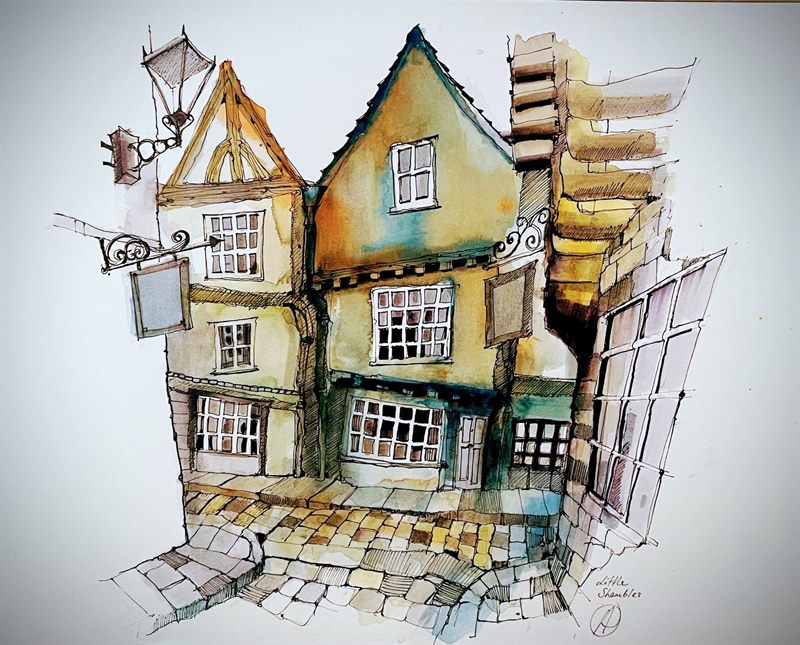
Great workshop with so much to learn - Ian's composition & colour choice is really interesting.
Amanda Oatway
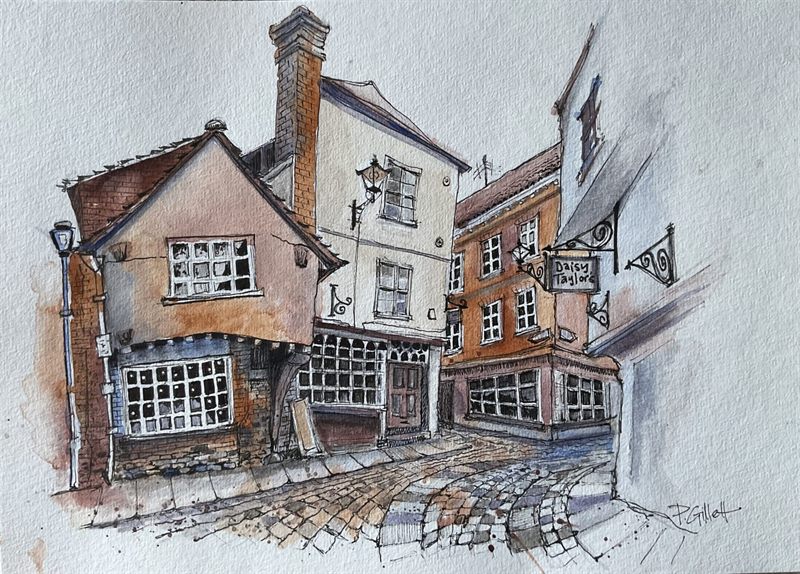
I love all Ian's online courses. His way of teaching and his humour all add to the experience. Will definitely do more.
Philippa Gillett
I enjoy Ian's personal reactions to the locations; I feel like I am there with him...I want to go into that bakeshop and get some goodies.
Don Dellow
A fun course that can be accessed by any ability. There is no fear of getting it wrong because of the quirky nature of the drawings.
Patricia Francis · Review on Trustpilot
Ian’s teaching is clear, thoughtful and generous. Each session feels purposeful and encouraging, and I always come away seeing a little more clearly.
Asmita Kapadia
I love how loose and relaxed Ian’s sketches are but through his workshops I have realised how very intentional his sketches are.
Adele Thomas
It gives you step by step instruction in real time (not sped up) of how Ian creates his sketches
Patty Edge
Every month has a new important topic with challenges, critiques, zoom meetings and contests... His Plus group is super because it connects us to people all over the world.
Dee, UrbanSketch+ member
I wanted something more artistic, with a lot more colour, where I could slow down.
Asmita Kapadia
I started the membership in February 2023 and it has become a very important part of my life.
Anja Saalberg, UrbanSketch+ member
Ian's sketches impressed me so much, I couldn't let go of the liveliness of the lines combined with wonderful colours, so I really wanted to find out more about them.
Anja Saalberg
Ian’s breakdown of steps through the sketch are very helpful.
Ron Dean
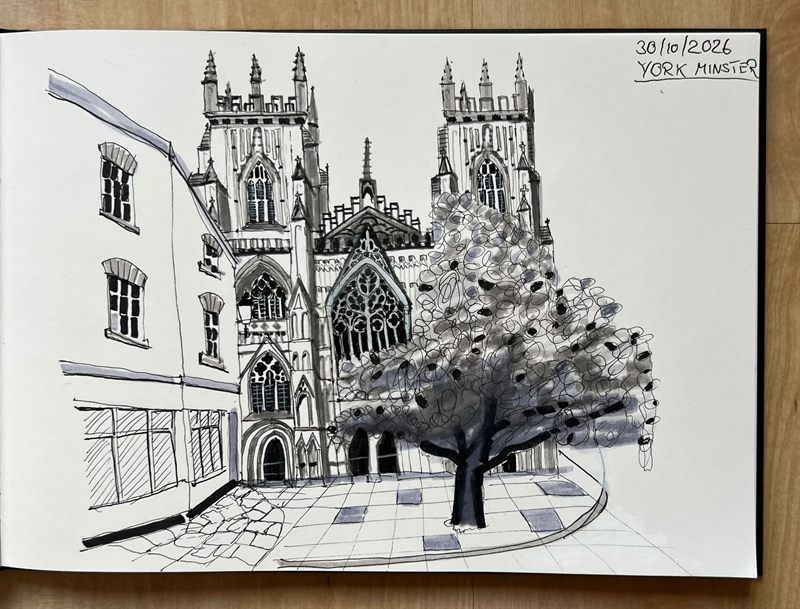
So I am quite happy that I finished this one.
Elke Haimhof
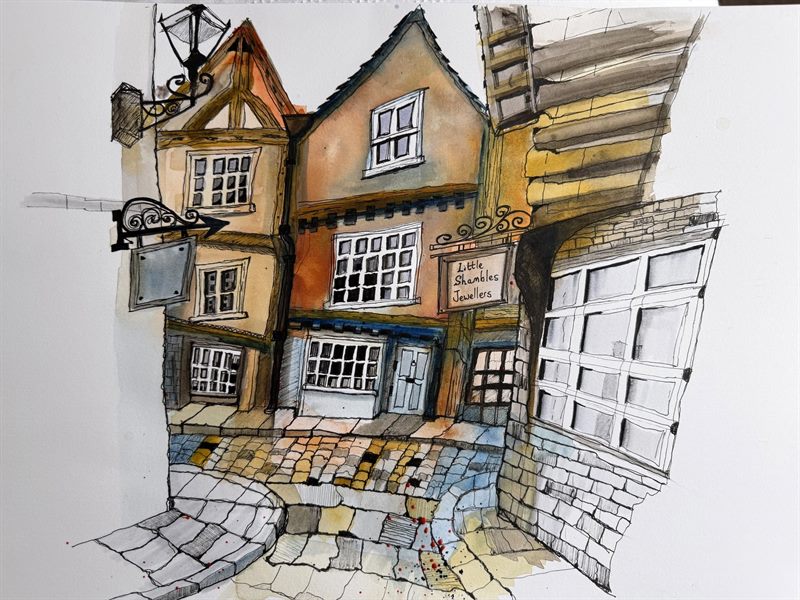
First one of Little Shambles, perspectives and beams, so challenging! I loved the colours in this one, lots to learn
Joanne Hopwood
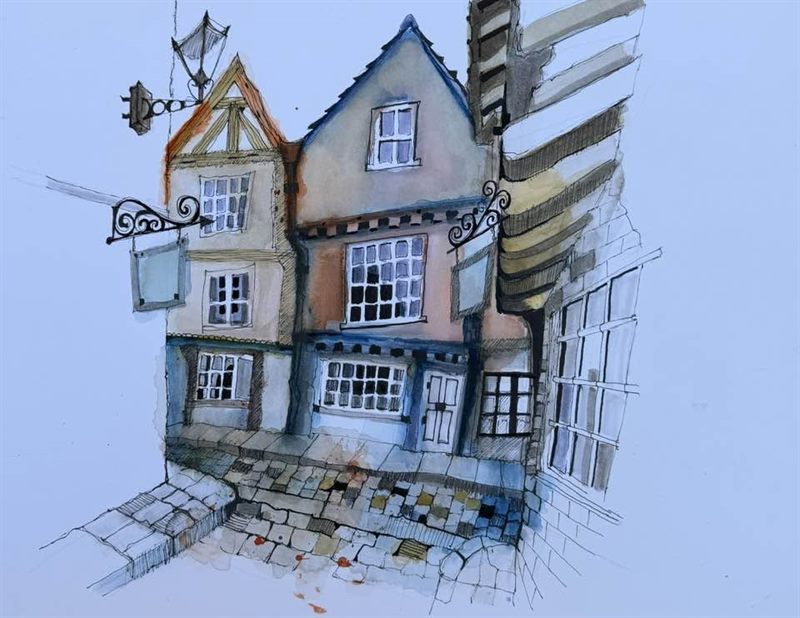
The Olde Sketch Course has provided me with both motivation and inspiration, so hopefully I will gain some confidence to tackle one of my scenes. The Little Shambles was challenging, but I am pleased.
Cheryl Miller
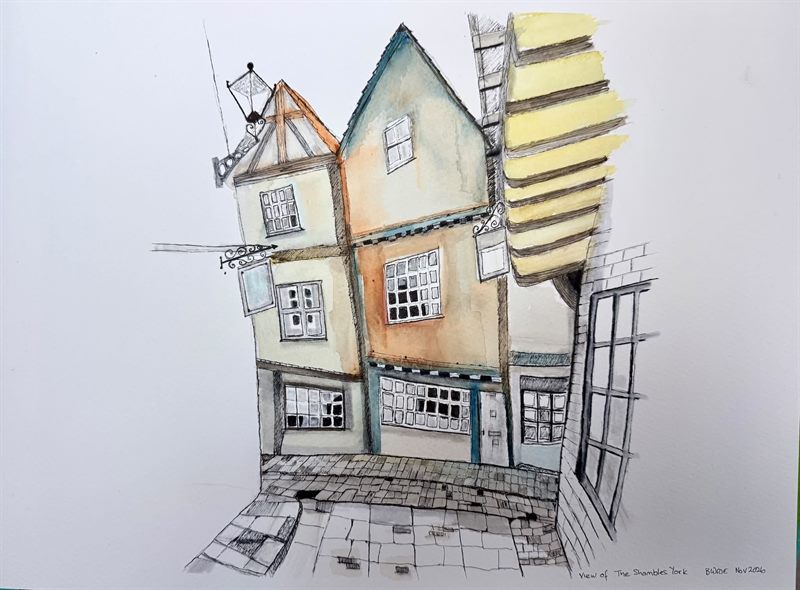
He takes all students (especially beginners) through the process of urban sketching step by step so that you can proceed at your own pace, watching each video clip several times if you wish to. I love the feeling that you are sitting there with him (virtually) as he does his demonstration sketch.
Brenda Wroe
This is not a recipe for how to be a true artist in 10 easy steps - don't believe in those. But it sure gives you the whole toolset for you to become an urban sketcher.
Valerio Marques
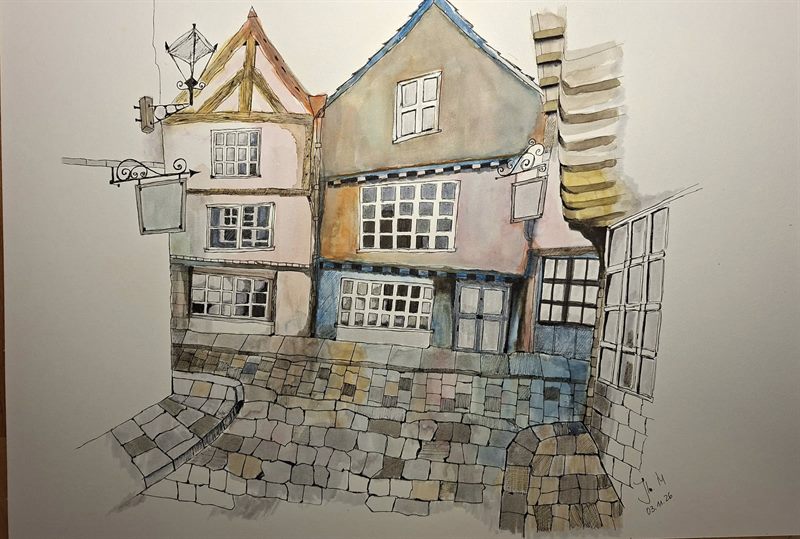
Mixing the colours to achieve that "aged" look was challenging, but the result is very convincing.
Anoli Mueller
More about this course
How Ian captures age
He takes two colours that sit opposite each other on the colour wheel, the way blue sits opposite orange, and mixes them so they calm each other down.
Get this right and what's left is the brown and grey of old timber. Then he adds the darks, a touch of white so a wall looks solid, and pen lines for the grain in the beams.
Knowing how much indigo, when to stop, and which colour to keep back for the light is what makes Ye Olde Sketch Course different from anything we've made before. In Workshop 2 you'll watch him run Burnt Sienna into wet indigo and see the instant effect it has.
Become the sketcher who can make an old street look old
One day you'll find yourself in an old street, on your travels or close to home. Timber beams bent with age, upper floors leaning out over the cobbles.
You'll feel how old it is the moment you see it. And after Ye Olde Sketch Course, that feeling comes home in your sketchbook.
Ian put it best, standing in the Shambles: “you're learning about the past while you're drawing in the moment.”
30 days
30-day money-back guarantee
If the course is not for you, tell us within 30 days of buying and we will refund you in full.
Ready when you are
- 5 workshops in York, each with pre-sketch training in the street
- 3 bonuses, including Ian's York Sketchbook and Ghosts & Tales of York
- Lifetime access, with free course updates
- 30-day money-back guarantee
Join 100K+ people learning with us.
Frequently asked questions
How easy is this course for a complete beginner?
The course has been designed for beginners to advanced artists who want to know Ian's tricks and techniques for making old buildings and ancient streets look as old on their page as they do in real life, using just 4 colours.
Old buildings are forgiving subjects. Their beams bow and their walls lean, so a wobbly line belongs in scenes like this.
Each of the 5 workshops comes with full pre-sketch training, so you can see the entire thinking process before you start your own.
If you can hold a pen and follow along, you can do this course.
What's the difference between this and Ian's other sketching courses?
Most of our sketching courses teach you to record what a place looks like. Ye Olde Sketch Course teaches you how to record what happened to it.
York's buildings have been bending, sinking and crumbling since the 1400s, and this whole course is built around getting that onto paper: four muted colours per workshop chosen to make things look their age, two brand new colours, and a final workshop with no colour in it at all.
After this you'll know the steps for making any building or street look old on your page. Ian has never taught this before.
Can I follow along with Ian while taking this course?
Yes. This is over-the-shoulder learning with Ian Fennelly.
Ian has broken each workshop down into easy-to-follow stages. Within each of those stages, he takes you through each step in the process while explaining everything he is doing, slowly and methodically.
You can slow down, pause, or speed up each tutorial to match your pace. Some students watch the videos first and then watch them again and sketch along. The choice is yours!
Plus, with lifetime access, you can revisit the course as many times as you like.
Can I learn this training any other way?
No. Ian has never taught these techniques in any of his other courses, live trainings or in-person retreats.
Ye Olde Sketch Course is the only course that teaches you how to sketch old buildings and make them look old on your page.
Do I need expensive art supplies?
No. Ian works with a compact kit: a sketchbook, fineliners, Tombow brush pens, and a small set of watercolour paints.
Each workshop uses only 4 watercolours. You do not need a full pan set. The whole point of the limited palette is that fewer colours produce better results.
How long will the course take?
The course is organised into short, manageable lessons across five workshops.
With lifetime access, you can go at your own relaxed pace and on your own schedule, and repeat any lesson as often as you like.
Do I get lifetime course access?
Yes. We call it forever access. It never expires, so you can learn at your own pace, on your own schedule, and on any device.
And if we update the course with new lessons, trainings or downloads, you'll get those too at no extra cost.