Six of London's landmarks, from Trafalgar Square and Piccadilly Circus to Chinatown and St Paul's, made simple enough to sketch.
See all 6 stepsWhat you'll be able to do
- Work in three fast stages: outline with tone, generous colour, then detail with fineliner and brush pen.
- Sketch the first shapes with the brushy part of a brush pen to describe forms quickly.
- Get far more information down in step one than usual because you may be moved on.
- Keep every part of the sketch at the same level of completion by bouncing around the page.
- Invent the colour to express the place, but keep flags and signage in their local colour.
- Use coloured brush pens over paint when you need colour with no drying time.
About this course
Overview
How to Finish a Stunning Urban Sketch in Under an Hour - Even Surrounded by Noise, Movement, and Mayhem
You’re standing in front of a beautiful, busy scene - and suddenly, your brain seizes up.
"Where do I even start?"
"Do I include that building?"
“What about all these people?"
"Is that lamppost important?"
"What if I leave out too much?"
So you start sketching…
You try to include everything. And you second-guess every line.
30 minutes later, your page is crowded, overworked, and unfinished. Again.
It’s one of the most common frustrations among urban sketchers.
It’s a painful truth:
Most sketchers don’t struggle with how to draw… They struggle with knowing what not to.
The real problem isn’t your linework.
It isn’t speed.
It’s vision.
You’ve been trained to look at a scene and try to copy everything.
But great urban sketches don’t capture everything.
They capture the essence.
And the way to do that - especially when you’re surrounded by noise, movement, traffic, pigeons, tourists, and chaos - is not to draw faster…
But to see differently.
Discover Ian Fennelly's 3‑Phase Visual Framing Method in this Sketch London Course
Inside, Ian reveals his 3‑Phase Visual Framing Method - the exact process he uses to decide what to draw, what to skip, and how to confidently finish a stunning sketch in under 60 minutes… and he proves it on the hectic streets of London.
This isn’t about techniques or templates.
It’s about learning how to see through the chaos - and frame your sketch like a visual storyteller.
And once you understand this method, the question isn’t "Where do I start?"
It’s "What do I leave out?"
6 Comprehensive Workshops
If you’ve ever found yourself frozen in front of a busy scene…
Or your sketches keep ending up unfinished or overloaded…
This course will change how you see, filter, and finish - forever.
Here's what's included in this comprehensive Sketch London training:
Who it's for
Do I need to be an artist to take this course?
Ian assumes no prior knowledge or experience. He has designed this course to enable anybody to start with a blank page, follow-along with his specific steps, develop new skills and produce a piece of work they will be very pleased with. Of course, if you have a certain level of artistic skill, then the techniques that Ian shares will help you to build upon your existing skills and give you a process that enables you to produce great work, in less time.Your learning path
6 workshops, in the order Ian teaches them. Work through them at your own pace; every step ends with a finished sketch.
Before you start
Advanced level
For confident sketchers who are ready for busier, more complex scenes. New to sketching? Start with the Beginners Course.
Workshop 1
Trafalgar Square
Learn how to filter chaos, connect contrasting architecture, and begin your sketching journey with confidence - even in London’s busiest landmark.
You'll practise
- Start with the fountain as the hook, then let the plinth and buildings structure around it.
- Paint the fountain in intense orange against pale buildings so it reads as the focal point.
- Work hard on the plain pavement with fine hatching so foreground, fountain and buildings connect.
Read the full workshop notes
- How to sketch in a sea of distraction - and still focus like a laser
Discover the mental framing move Ian uses to block out the noise, people, and pigeons - so you can stay calm and focused, even in total urban overwhelm. - Why starting at the fountain unlocks the entire scene
See how anchoring your sketch in the centre helps you naturally expand outward - connecting buildings, monuments, and movement into a single coherent flow. - The secret to connecting unrelated structures (without making it feel stitched together)
Learn Ian’s subtle shape-mirroring move that makes the National Gallery, Nelson’s Column, and St Martin-in-the-Fields feel like they belong together - even though they were never designed that way. - When less shadow says more
Use Ian’s minimalist tonal approach to suggest depth and form - even when buildings are blocky, flat, and sitting in bright daylight. - What to ignore when the architecture starts shouting at you
Learn how to silence visual noise by identifying "contrast anchors" - so you capture the spirit of a place, not just its outlines. - The directional flow trick that makes your sketch feel alive
Discover the invisible "Z-path" that guides the eye through the square - and how Ian uses it to build momentum into the sketch without crowding the page. - How to make a lion sit still (without ever drawing it properly)
Steal Ian’s shortcut for suggesting movement and mass in iconic figures - so you can sketch quickly without getting bogged down in anatomy. - ...and so much more.
From spire to square, brush pen to water brush — this workshop breaks down how to start strong, stay focused, and bring unity to complexity.
Workshop 2
Piccadilly Circus
Learn how to handle movement, visual chaos, and iconic shapes - and turn one of London’s busiest intersections into a bold, energetic urban sketch.
You'll practise
- Rough in Eros, the fountain and the steps with the brush tip to fix the space they occupy.
- Treat the dominant steps in three different ways so they integrate rather than take over the scene.
- Reverse the billboard lettering from dark-on-light to light-on-dark to make it belong to the picture.
Read the full workshop notes
- The bold black-line secret that gives your sketch instant structure
See how Ian uses strong brush-pen lines to "own the page" and anchor the scene — before detail, tone, or colour ever touch the paper. - Why sketching curved architecture is easier than you think
Learn the flexible framing move Ian uses to tame the chaos of Piccadilly’s curving facades - without getting lost in perspective math. - How to turn crowds into characters (without drawing every figure)
Discover Ian’s loose, expressive gesture technique that makes people feel alive - even when they’re just a few quick marks on the page. - The colour splash strategy that brings energy to your sketch
Watch how Ian uses punchy reds, deep shadows, and selective detail to guide the viewer’s eye - and make the sketch feel dynamic without being busy. - Where to push distortion - and why it makes the scene more believable
See how Ian exaggerates certain lines and shapes to heighten mood and movement - so the sketch feels real, even when it’s far from literal. - What to leave out when everything is screaming for attention
Learn how Ian picks focal points fast - and how he builds contrast and connection between the chaos and calm. - The "white space pulse" that keeps your sketch breathing
Discover the technique Ian uses to balance bold areas with quiet ones - so your sketch has rhythm, energy, and visual rest. - ...and so much more.
From curved signs to moving figures - this workshop gives you the tools to stay bold, stay loose, and sketch with clarity under pressure.
Workshop 3
China Town
Discover how to bring colour, culture, and controlled chaos into your sketch - without getting overwhelmed by signs, movement, or visual noise.
You'll practise
- Draw the eye line first, then build the pagoda and signage off it and leave the diners out.
- Paint the Prussian blue space between the lanterns so they pop, then reverse and paint some lanterns.
- Match the London brick in raw sienna as a local anchor amid the otherwise wild, abstract colour.
Read the full workshop notes
- How to tame visual overload when every inch of the scene is shouting at you
Ian reveals the fast framing trick he uses to create order from Chinatown’s explosion of signs, lights, people, and movement - so your sketch feels composed, not chaotic. - Why the most important shapes in Chinatown aren't architectural
Learn how Ian prioritises symbolic objects - lanterns, signage, cultural markers - to bring emotional and narrative depth into the sketch fast. - The secret to using red boldly (without blowing out your page)
See how Ian creates balance by pairing strong colour with neutral contrast - so your sketch pops, but still holds together. - How to suggest complexity without drawing it all
Discover Ian’s layered tone technique that lets you imply intricate elements like signage and storefronts - with just a few decisive marks. - What to leave out when a place is full of energy, but low on space
Learn Ian’s spacing instinct that allows the eye to breathe - even when every square foot of the real-world scene is packed. - The cultural rhythm technique that gives your sketch an authentic pulse
Watch how Ian uses repeating patterns, motifs, and movement to create flow - so your viewer feels the beat of the space. - The brush flick move that makes lanterns glow (without using light)
Ian demonstrates how to make flat objects feel dimensional - just by manipulating edge, colour, and line. - ...and so much more.
From colour control to cultural storytelling - this workshop gives you the tools to sketch vibrant scenes full of life, without losing control.
Workshop 4
Tower Bridge
Learn how to break down one of London’s most iconic (and intimidating) structures - and how to keep your sketch moving, even when the details want to slow you down.
You'll practise
- Keep an iconic building faithful in shape and play with colour instead: warm near tower, cool far.
- Draw widely spaced plumb lines for the brickwork first, then fill between them to hold direction.
- Wait for the yellow wash to dry, then put the steel supports in their true cerulean blue.
Read the full workshop notes
- The "bridge sandwich" technique Ian uses to anchor the entire sketch
Discover how Ian stacks land, river, and architecture into a flowing composition - so you always know where to start, and how to expand without losing your way. - Why Ian bends the bridge - and why your sketch should too
Learn the distortion trick that makes your sketch feel more alive and dynamic than a photo - even when the building is symmetrical and rigid. - The step-by-step method for tackling repeating shapes (without drawing them all)
Ian reveals how to suggest detail - like towers, windows, and beams - without getting stuck in repetition or overwork. - How to sketch motion on a static bridge
See how Ian weaves in cars, people, and perspective movement to give Tower Bridge life and story - even when everything around it stands still. - The colour pairing trick that creates structure and softness at the same time
Watch how Ian uses warm tones and blues to keep the sketch grounded - while letting the brush do most of the heavy lifting. - What to leave out when the bridge demands too much attention
Discover how to balance bold architecture with soft edges and selective contrast - so your viewer sees what matters most. - The directional line technique that pulls the eye through the bridge
Ian shows how to guide the viewer’s gaze with leading shapes - turning a complex crossing into a smooth visual journey. - ...and so much more.
From arches to anchors - this workshop gives you the confidence to take on big landmarks without overthinking or overworking your sketch.
Workshop 5
St. Paul's Cathedral
Learn how to capture movement, depth, and dynamic structure - and how to make your sketch flow with purpose from foreground to skyline.
You'll practise
- Dive into fineliner detail straight after the loose brush pen outline when time is short.
- Invent bright tonal colour for the bridge because the real scene is grey and flat.
- Leave the space under the bridge unpainted so its shape and colour stand out against light.
Read the full workshop notes
- The leading-line secret that gives your sketch instant direction
See how Ian uses bold perspective lines from the bridge to pull the viewer’s eye straight through the scene - creating energy and focus from the first mark. - How to anchor a moving crowd without drawing every person
Discover Ian’s loose gesture technique that captures flow and pace - so people feel alive, without freezing your sketch in complexity. - Why a simple triangle creates unstoppable momentum
Learn how Ian uses visual geometry to lead the eye from bridge to dome - making St Paul’s feel perfectly placed and powerfully intentional. - The brush-and-smudge move that builds soft atmosphere fast
Watch how Ian uses blur, tone, and brushwork to suggest light, space, and movement - without relying on slow detail. - What to leave out when everything converges at once
Ian reveals how to simplify a visually complex vanishing point - and still preserve depth, energy, and clarity. - The skyline compression trick that makes buildings feel connected
Learn how Ian flattens visual distance without losing storytelling - so your scene feels cohesive and alive. - The tonal balance move that stops your sketch from leaning or drifting
Discover how Ian holds contrast across the bridge - and why certain shadows matter more than others. - ...and so much more.
From vanishing lines to vibrant tone - this final workshop ties together structure, movement, and emotion into a single, fluid sketching experience.
Workshop 6
Smithfield Market
Learn how to sketch grand, historic buildings with strength and style - and how to turn repetition and symmetry into bold storytelling.
You'll practise
- Drag the street sign post thirty metres into the picture because it tells the story of the place.
- Start with sensible local colour for signage and brick, then break the arch shadow into three colours.
- Write the lettering in brush pen, then go over it in fineliner to make it three-dimensional.
Read the full workshop notes
- The framing-first strategy Ian uses to sketch confidently without hesitation
Discover how Ian starts by locking in the shape of the building’s "spine" - so the entire sketch falls into place naturally, without guesswork. - Why less colour creates more atmosphere
Learn Ian's restrained palette approach - and how subtle reds and shadows can do more storytelling than a rainbow of detail. - How to simplify repeating arches and rhythm — without losing character
See how Ian suggests symmetry through contrast and shape — so your sketch feels structured without being stiff or overworked. - The distortion decision that makes flat buildings feel full of life
Ian shows you how pushing perspective slightly gives older architecture more character - without compromising the structure’s identity. - What to ignore when everything feels too linear
Learn how Ian filters out excessive linework and focuses on essential contrasts - turning a maze of rectangles into a strong, readable scene. - The layering trick that makes shadows tell the story
Watch how Ian uses depth and tone to bring out subtle forms - so your sketch breathes with dimension, even without heavy detailing. - The "soft boldness" principle that keeps big buildings light
Discover Ian’s technique for combining structural strength with airy suggestion — so your urban sketches don’t feel weighed down by the architecture. - ...and so much more.
From historic facades to subtle framing - this workshop shows how to sketch big scenes with calm, clarity, and creative confidence.
When you finish
What you'll have at the end
6 finished sketchesOne for every step, in your own sketchbook.2 bonusesExtra workshops and resources to keep going.Yours to keepCome back to any lesson whenever you like.Workshop GalleryUpload your sketches, see how others sketched the same scene, and swap feedback.
Why Sketch London?
Landmarks made simple
Trafalgar Square, Piccadilly Circus, Chinatown, Tower Bridge, St Paul's and Smithfield Market are tackled in three fast stages: outline with tone, generous colour, then detail.
Colour that expresses place
You invent colour to express the place, such as an intense orange fountain, while flags and signage keep their local colour.
Information down early
You get far more information down in step one than usual, in case you are moved on, and keep every part of the sketch equally finished.
Ready when you are
Start Sketch London today
Short lessons, yours to keep, and a 30-day money-back guarantee.
What else comes with the course
2 extra workshops and resources are part of the course, so the learning carries on after the last location.
Included with this course
Speed Sketching Workshop
Included with this course
Urban Sketchers Feedback Gallery
About your instructor
Ian Fennelly has earned a global reputation as one of the world’s most inspiring urban sketchers and teachers.
Having lived and studied art in London for many years, returning to the city to create this course was more than a project - it was a personal mission.
With Sketch London, Ian wanted to do more than revisit familiar streets. He set out to design a course that shows you how to simplify complex scenes, sketch faster, and capture the heart of a place - even in the middle of chaos.
Filmed on location across London’s most iconic spots, each workshop gives you a front-row seat to Ian’s process.
You’ll see exactly how he makes sense of busy, detailed environments and turns them into confident, expressive sketches - in real time.
Whether it’s the crowds of Trafalgar Square, the movement of Millennium Bridge, or the vibrant colour of Chinatown, this course will teach you how to see differently, think decisively, and finish your sketches with clarity and freedom.
Sketches by students of this course
What students say
I am now hooked on splashing the paint on with lots of water and, in Ian’s words, letting the colours play together. I have also, at last, found a way of sketching trees that I enjoy. Ian’s approach is a joy to do.
Pam Rhodes
I have purchased all they have and improved as an artist (yes, I now feel I can call myself an artist :-) beyond what I could have ever hoped.
Scott Peterson
I'm 61 years young and took up watercolours after retiring from nursing. I've taken a few online classes and this one is my absolute favorite!
Mary Baldree
i am totally in awe of the engineer/architect who designed this amazing structure.
Karen Mirande
Got a bit lost in the middle and know what i can improve on, but really enjoyed this busy scene.
Sharon Thomas
His easy teaching style and humour are great if you are wanting to start or rediscover your creative juices. Thoroughly recommended.
Gary Wild
I am learning so much, every workshop have greatly increased my ability to create the quality and style of artwork I want to do.
Ronda Ranne Guy
Enjoyed the subjects you choose and how you choose them. The different techniques Ian teaches. It’s interesting how his brain works when he’s creating.
Julie Bruss
I am home bound and can't go out to sketch, but thanks to these wonderful tutorials I can sketch along and have the joy of painting.
Melissa McCutcheon
Learned a lot more about tone. Just generally everything.
Wendy Parker
I really fell in love with this technique!
Julie Martel
Love Ian's style
Debbie Radicchi
I started the membership in February 2023 and it has become a very important part of my life.
Anja Saalberg, UrbanSketch+ member
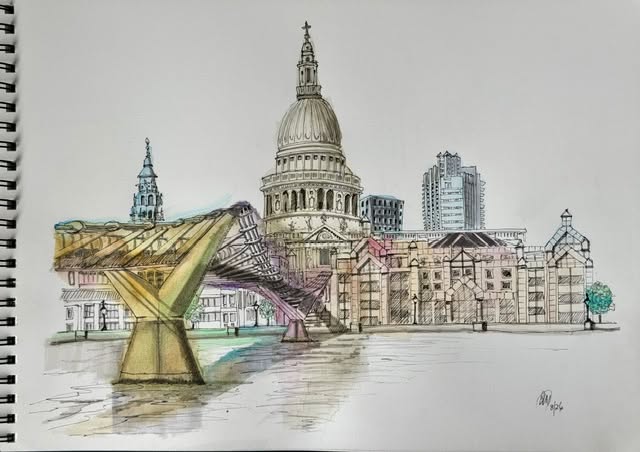
The bridge is quite tricky, and I liked the way Ian used his colour in his version.
Bruce Mitchell
He’s funny, informative and entertaining while guiding you step by step along the way!
Joanie Crombie
The community of this Urban Sketch Course is just so uplifting, everyone is so supportive
Marlies
This is a very good course, it can be taken in slow easy steps at your own pace. You can also dip in an out is you have forgotten a step.
Sarah Vipond
I found myself captivated by his style.
Jenny Le Blique
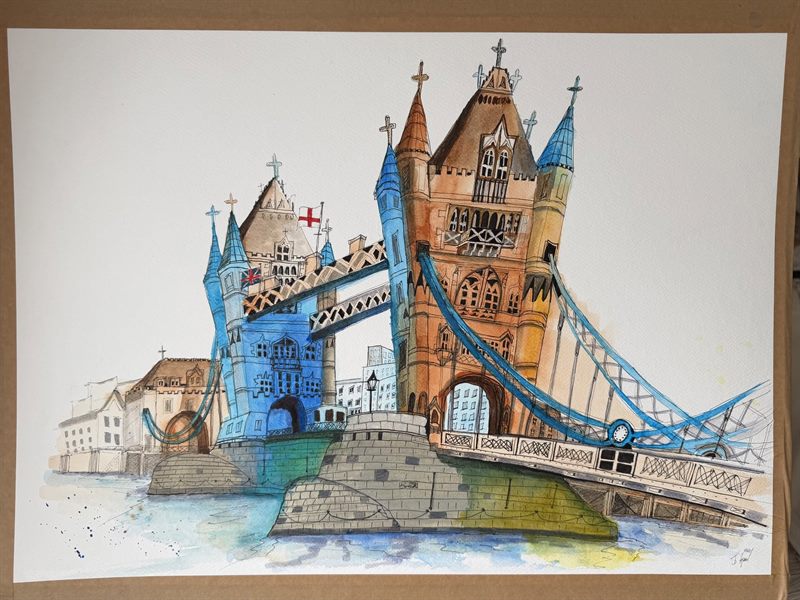
Did it on A2 and overall pleased with result. I had a few problems with perspective! Really looking forward to trying the rest of the sketches from this set now.
Joanne Hopwood
This is not a recipe for how to be a true artist in 10 easy steps - don't believe in those. But it sure gives you the whole toolset for you to become an urban sketcher.
Valerio Marques
More about this course
You're Just One Course Away from Seeing the World - and Your Sketches - Differently
If you've ever frozen in front of a busy scene, unsure where to begin or what to leave out - Sketch London will change the way you see forever.
You’re not getting another load of drawing techniques. You’re getting Ian Fennelly’s personal 3‑phase framework - forged on the streets of one of the world’s most chaotic cities - that shows you how to filter the noise, fast, and capture only what matters.
And the best part? You can apply this same method to any urban sketch you make from this point on - in any city, any environment, anywhere.
100% Satisfaction Guarantee
If you go through the course and don’t feel more confident, more focused, and more capable of finishing your sketches in under an hour - just email us within 30 days for a full refund. No fuss. No hard feelings. We're here to support your sketching journey, not slow it down.
Why This is a No-Brainer
For less than the cost of a few art supplies or a single live workshop, you’ll get a lifetime seat beside one of the world’s leading urban sketchers - watching over his shoulder, learning how he thinks, filters, and finishes in real time.
And with 6 location-rich workshops filmed across London, you’ll see this method in action across dramatically different scenes - from soaring cathedrals to chaotic crowds.
Join Sketch London and start seeing your surroundings - and your sketchbook - in a whole new way.
Once you understand Ian’s three-phase Visual Framing Method, you’ll realise that Urban sketching isn’t about drawing everything - it’s about knowing what to leave out.
30 days
30-day money-back guarantee
If the course is not for you, tell us within 30 days of buying and we will refund you in full.
Ready when you are
- 6 workshops, each a full sketch from first line to last wash
- Lifetime access: watch, pause and rewatch as often as you like
- Resources, reference photos and colour notes to keep
- 30-day money-back guarantee
Join 100K+ people learning with us.
Frequently asked questions
Can I follow along with Ian while taking this course?
Yes. This is over-the-shoulder learning with Ian Fennelly.
Ian is an experienced and engaging teacher and has broken each workshop down into easy-to-follow stages. Within each of those stages, he takes you through each step in the process while explaining everything he is doing, slowly and methodically.
You have the flexibility to slow down, pause, or speed up each tutorial to match your learning pace. Some students also prefer to watch the videos first and then watch them again and sketch along. The choice is yours!
Plus, with lifetime access, you can revisit the course as many times as you like.
Can I take the workshops in any order?
Yes. All 6 workshops are accessible from day 1 so that you can pick and choose which ones you work on.
I don't live in London. How will this course help me?
Being a UK based artist, Ian chose London for its rich history, its world famous landmarks, and most importantly - to show you firsthand his methodology for sketching incredible urban artwork, even in the busiest of locations and/or when you don't have a lot of time on your hands.
Urban Sketch has learners from over 70 countries, so everything you'll learn from this course can be applied to almost any location and situation. You'll also be given the images to follow along with at home, as Ian walks you through his process. We think you'll find this course thoroughly enjoyable and we think you'll agree that London was the perfect spot!
How straightforward is it to navigate this online course?
Our learning platform is incredibly user-friendly. Each workshop tutorial features step-by-step videos, supplemented with additional guidance and interactive elements to enhance your learning experience. Just navigate through the lessons and play the videos as you proceed.
Do I get lifetime course access?
Yes, you'll receive lifetime access to the course along with all accompanying downloads and resources. It never expires, allowing you to learn at your own pace, on your schedule, and any device.
Why didn't you include Big Ben in this course?
No one was more disappointed than Ian to not have Big Ben included in this course! Watch the short video below for an explanation as to why Big Ben was not included in London's Greatest Hits: